Sunday, November 11, 2007

Excessive Speaking Fees for Bill Clinton?

According to the Washington Post, Bill Clinton earned $31 million in speaking fees between 2001 and 2005, as disclosed in his wife's Senate ethics reports. The chart above (click to enlarge) lists the amount Bill Clinton earned for 43 speeches he gave in 2005.

Working less than one day a week, Bill Clinton earned almost $7.5 million in 2005, making an average of about $174,000 per one-hour speech. In other words, Bill Clinton earns more in one hour than the average American makes in about 6 years ($29,544 per year), and certainly earns much on an hourly basis than the average CEO of a large corporation, who probably has to work 50-60 hours per week to earn $10.8 million per year on average in salary and bonuses in 2007.

According to this report from Social Funds, "While Americans have been concerned about the widening pay gap for years, what is different now is that this concern is beginning to impact lawmakers. Several bills addressing executive pay are pending in the House and the issue is gaining the attention of some high profile politicians, including Barak Obama and Hillary Clinton."

Just wondering... if the Clintons are so concerned about excessive CEO pay, why is Bill Clinton charging $174,000 per hour to give speeches, in addition to receiving an annual pension of $186,000 from the government? Or if Clinton is just charging "whatever the market will bear" for his speaking services, how is that different than highly-skilled managers charging "whatever the market will bear" for their managerial services?

Thursday, March 06, 2008

Comparing Income Taxes: Clinton vs. Bush

Despite all of the political rhetoric about "tax cuts for the rich" and the "middle class squeeze," a recent analysis by the Tax Foundation shows that federal income taxes have fallen for groups at all income levels as a result of the Bush tax cuts, compared to the 1999 tax rates under Clinton (see chart above). And in fact, the group in the chart above that experienced the largest percentage decrease in taxes were the married taxpayers with $50,000 of household income (clearly middle class by most definitions) - they paid 21% less in taxes under the Bush tax rates compared to the Clinton rates. By contrast, "rich" single taxpayers with income of $125,000 paid only 10% less in taxes. In other words, some middle-class taxpayers received twice the tax cut on a percentage basis as some of "the rich." .....So much for the claim that "the Bush Administration and Congressional policies are failing middle-class Americans."

Both Hillbamas want to extend the tax cuts for the middle-class but not for "the wealthy."

Here's my challenge to Hillbama: Both of them are clearly part of "the wealthy," and pay federal income taxes at the highest current marginal income tax rate of 35%. Obama's income in 2007 was about $1 million, and just one or two speeches by Bill Clinton at $200,000 puts the Clinton household income into the top tax bracket (in 2006, Clinton earned $10 million in speaking fees).


If they want to end the tax cuts for "the wealthy," they don't have to wait for the Bush tax cuts to expire at the end of 2010, they can voluntarily pay taxes right now at the old 1999 rates under Clinton. In other words, if the highest marginal rate of 35% is too low for the wealthy Hillbamas, they could make a strong, personal statement right now by voluntarily paying their 2007 taxes at the old highest marginal rate of 39.6%. In fact, Hillbama, Warren Buffet and anybody else opposed to the Bush tax cuts, can voluntarily pay taxes this year under the 1999 Clinton tax rates, instead of the current tax rates (see chart below, click to enlarge). If higher taxes on the wealthy in the future are good, shouldn't they also be good right now?

Here's an idea: Why doesn't TurboTax introduce tax preparation software based on previous years' higher marginal tax rates, to easily allow people like Hillbama, Warren Buffet and other anti-Bush tax cut advocates to pay at their preferred higher rates, instead of the new lower rates. Alternatively, The Tax Foundation has historical income tax rates back to 1913 here. If 39.6% from 1999 is too low, Buffet et al. could file under the 1960s highest marginal tax rate of 91%, the 1970 tax rate of 70%, or the 1980s tax rate of 50%.

(HT: Juandos)

Friday, February 15, 2008

Show Us The Money

NY Times Editorial -- As the presidential campaign narrows and its costs skyrocket, detailed disclosure of financial resources becomes ever more important. Of the leading contenders, so far, only Senator Barack Obama has released his full income-tax returns — a level of disclosure once routine for candidates after the political corruption of Watergate.

The need for greater transparency regarding the income and overall financial dealings of candidates and their spouses was underscored by Mrs. Clinton’s recent decision to make a $5 million loan to her campaign. Such borrowing is a permitted practice under the campaign laws. But the campaign said the money came from her share of the Clintons’ joint resources, and that calls attention to the lack of information about their family finances. As a former president, Bill Clinton has been making millions annually giving speeches and traveling the globe ($7.5 million in 2005, see this CD post). What is publicly known about his business dealings is sketchy, and clearer disclosure of them is required to reassure voters that Mrs. Clinton’s candidacy is unencumbered by hidden entanglements.

The reluctance of Mrs. Clinton and Mr. McCain to reveal more about their finances ill-serves voters and the nominating process of both parties. It also sets a terrible precedent for future campaigns for important posts at the national and state level.

Saturday, November 10, 2007

Challenge: Raise Taxes on Your Rich Selves Now!

All of the major Democratic presidential candidates would allow the 2003 tax cuts for wealthier households to expire. Most support raising the cap on income subject to Social Security taxes. Some want to raise taxes on capital gains and other investment income.

On Capitol Hill, a leading Democrat - Rep. Charles Rangel - has proposed an additional tax on wealthy people and a levy on hedge fund managers to help pay for easing taxes on the middle class.

In 2005 (most recent year available) it took income of $145,283 to be in the top 5%, according to
IRS data. Members of Congress earned a base salary of $162,100 in 2005, putting each member of Congress into at least the top 5% category and making them part of the group most would agree is "the rich."

Given Bill Clinton's $9-10 million in income from speeches
in 2006 (see a list here), the Clintons are probably the kind of super-rich Americans in the top 1/10 of 1% that John Edwards has in mind when he unveiled his plan to raise taxes on the rich: "The top 300,000 income-earners in America now make more than the bottom 150 million combined. Our tax code has shifted most of the burden onto the backs of working Americans."

When a presidential candidate like John Edwards or Hillary Clinton, or a tax-raising member of Congress like Rep. Rangel, tells us that they think taxes should be raised on the rich (which includes themselves), isn't it a fair question to ask them how much they voluntarily added to their tax bill this year, and how much they plan to add next year? After all, if they think "the rich" should pay more taxes, shouldn't they already be doing so voluntarily?

Challenge: If taxes increases for "the rich" are a good thing, the members of Congress and presidential candidates (all part of either "the rich" or "super-rich") don't have wait for the Bush tax cuts to expire or for Congress to pass new tax legislation, they can immediately raise taxes on themselves voluntarily by making a gift to the U.S. Treasury.

Here is the link to the
Treasury's website with instructions for politicians, presidential candidates, or any citizen who wish to make a general donation to the U.S. government into an official account called "Gifts to the United States."

For example, what if Edwards, Rangel or Clinton proposed legislation to force everybody to "donate" 5 pints of blood every year. Wouldn't it be a lot more credible if they were already donating blood themselves right now voluntarily, and not waiting until they were forced to "donate" blood by their own legislation
?

Friday, February 23, 2007

Clinton: Windfall Profits on the Lecture Circuit

From the Washington Post, Bill Clinton has made close to $40 million in speaking fees since leaving office. On one particularly good day in Canada, Clinton made $475,000 for two speeches, more than double his annual salary as president.

See a list of his speeches and fees here, minimum Clinton fee is $100,000, maximum is $400,000 and average is probably about $150,000 to $175,000.

His income in 2005 was about $8 million from speeches. And you thought CEOs were overpaid!

Monday, August 04, 2008

Windfall Profits Tax:It's What They Do in Venezuela

In other words, a windfall is nothing more than a profit earned by a business that some politician dislikes. And a tax on that profit is merely a form of politically motivated expropriation. It's what politicians do in Venezuela, not in a free country.

~WSJ Editorial

MP: Just wondering about Bill Clinton's $31 million in speaking fees between 2001 and 2005, wasn't that a "windfall"? See chart above (click to enlarge) of the $7.5 million in Clinton's fees in 2005 alone.

Wednesday, September 17, 2008

Politicians' Hypocrisy: Do As I Say, Not As I Do

Reason Magazine asks: Why should other Alaskans be arrested for something Sarah Palin once did with impunity?

When it comes to questions about youthful marijuana use, Sarah Palin is no Slick Willie. "I can't claim a Bill Clinton and say that I never inhaled," the Republican vice presidential candidate
told the Anchorage Daily News in 2006 (Palin said she has smoked marijuana -- remember, it was legal under state law, she said, even if illegal under U.S. law -- but says she didn't like it and doesn't smoke it now), before she was elected governor of Alaska.

Although Palin's handling of the issue scores higher on the candor meter than Clinton's, she has the same difficulty reconciling her personal experience with her policy positions, a problem also shared by former pot smoker Barack Obama. None of them has a persuasive answer to the question of why other Americans should be arrested for something they did with impunity.

Chart above is from NORML.

Monday, July 25, 2011

2010 House Vote Portends an Obama Loss in 2012

AEI Fellow Michael Barone presents some really interesting political analysis in his article "How to Understand Obama’s Chances in 2012":

House VotePresidential Vote
YearRep% Dem%      Rep%Dem%
20105245
200843544653
20064553
200450475148
20025146
200048484848
19984948
199649494149
19945244

"To what extent can we consider the popular vote for the House in off-year elections as a prediction of the presidential vote in the next election? The answer appears to be: pretty good. The chart above shows the Republican and Democratic percentages for the House popular vote and for the presidential popular vote, starting with 1994.

In the three most recent cases, the off-year percentages for the House are almost exactly the same as the presidential year percentages for president. However, Republicans signally failed to replicate their 1994 House percentage in the 1996 presidential contest. They would have been closer if 6% of the 8% cast for independent candidate Ross Perot is counted for Republican nominee Bob Dole—who polls suggested was the second choice of the overwhelming percentage of Perot voters—but that would still have left Clinton ahead 51%-47%.

Absent a considerable redefinition by the incumbent president, he or his party’s nominee is likely to run just about as well (or poorly) in the next presidential election as his party’s House candidates did in the most recent off-year elections.

Obviously, the three most recent examples portend an unhappy 2012 for President Obama and the Democrats, while the 1994-1996 example is a precedent for an incumbent Democratic president overcoming a “thumping” (George W. Bush’s term) in the off-year and winning reelection by a nontrivial margin. 

What I think these numbers suggest is that, absent a considerable redefinition by the incumbent president, he or his party’s nominee is likely to run just about as well (or poorly) in the next presidential election as his party’s House candidates did in the most recent off-year elections. The off-year vote represents a settled opinion on how the president and his party have performed in nearly two years in office, and unless the president takes a significantly different course toward governing, as Bill Clinton arguably did in 1995-1996, then that settled verdict remains more or less in place. Or so the numbers suggest."

Monday, November 14, 2011

Happy Birthday P.J. O'Rourke

It's P.J. O'Rourke's 64th birthday today, here are some quotes:

1. Giving money and power to government is like giving whiskey and car keys to teenage boys.

2. If you think health care is expensive now, just wait until you see what it costs when it’s free.

3. The Democrats are the party that says government will make you smarter, taller, richer, and remove the crabgrass on your lawn. The Republicans are the party that says government doesn't work and then they get elected and prove it.

4. The mystery of government is not how Washington works but how to make it stop.

5. The Clinton administration launched an attack on people in Texas because those people were religious nuts with guns. Hell, this country was founded by religious nuts with guns. Who does Bill Clinton think stepped ashore on Plymouth Rock?

6. Social Security is a government program with a constituency made up of the old, the near old and those who hope or fear to grow old. After 215 years of trying, we have finally discovered a special interest that includes 100 percent of the population. Now we can vote ourselves rich.

7. When buying and selling are controlled by legislation, the first things to be bought and sold are legislators.

8. No drug, not even alcohol, causes the fundamental ills of society. If we're looking for the source of our troubles, we shouldn't test people for drugs, we should test them for stupidity, ignorance, greed and love of power.

9. If government were a product, selling it would be illegal.

10. Feeling good about government is like looking on the bright side of any catastrophe. When you quit looking on the bright side, the catastrophe is still there.

11. America wasn't founded so that we could all be better. America was founded so we could all be anything we damned well pleased.

12. Bureaucrats want bigger bureaus. Special interests are interested in whatever's special to them. These two groups bring great pressure to bear upon politicians who have another agenda yet: to cater to the temporary whims and fads of the public and the press.

13. People who are wise, good, smart, skillful, or hardworking don't need politics, they have jobs.

14. If we're going to improve the environment, the first thing we should do is duck the government. The second thing we should do is quit being moral. Screw the rights of nature. Nature will have rights as soon as it gets duties. The minute we see birds, trees, bugs, and squirrels picking up litter, giving money to charity, and keeping an eye on our kids at the park, we'll let them vote.

15. The U.S. Constitution is less than a quarter the length of the owner's manual for a 1998 Toyota Camry, and yet it has managed to keep 300 million of the world's most unruly, passionate and energetic people safe, prosperous and free.

16. When you look at the Republicans you see the scum off the top of business. When you look at the Democrats you see the scum off the top of politics. Personally, I prefer business. A businessman will steal from you directly instead of getting the IRS to do it for him. And when Republicans ruin the environment, destroy the supply of affordable housing, and wreck the industrial infrastructure, at least they make a buck off it. The Democrats just do these things for fun.

Saturday, March 01, 2008

McCain:Free Trade; Clinton, Obama: Intervention


The charts above (click to enlarge) are from Cato Institute's "Free Trade, Free Markets: Rating the Congress," an interactive web site that allows users to examine how Congress and its individual members have voted on bills and amendments affecting the freedom of Americans to trade and invest in the global economy.


You can search by individual member of Congress, or by a particular bill, or by party breakdown on a particular bill, see below:


Bottom Line: When it comes to the voting records of the main presidential candidates on free trade, John McCain is clearly a "Free Trader," Hillary Clinton is clearly an "Interventionist," and Obama is leaning towards being an "Interventionist." It's also the case that Republicans as a group have a much stronger free trade voting record than Democrats on most bills. With either Clinton or Obama in the White House, we can probably expect more protectionism and less free trade.

Thursday, November 09, 2006

The Rise of Anti-Trade Lou Dobbs Democrats: Free Trade Has Left the Building

From yesterday's Slate.com, an article titled "The Lou Dobbs Democrats: Say Hello to the New Economic Nationalists," about how many of the Democrats who recaptured seats held by Republicans ran hard against free trade, globalization, and any sort of moderate immigration policy.

Economic nationalism begins from the populist premise that working people aren't doing so well. But instead of blaming the rich at home, it focuses its energy on the poor abroad. The leading economic nationalist today is Lou Dobbs, who on nights other than Election Night natters on against free trade, outsourcing, globalization, and immigration on CNN.

Economic nationalism is not unique to Democrats—nor is it a new theme. The protectionist wing of the party emerged in the 1980s when America's manufacturing decline was first linked to imports and foreign competition. During his 1992 campaign, Bill Clinton made a key decision to support NAFTA. Clinton espoused a strong free-trade position and embraced globalization through his presidency.

See a related post from Greg Mankiw's here: "Which Party Favors Free Trade?"

As a result of this year's election, it now seems unlikely that the new Congress will extend George W. Bush's "fast-track" trade-negotiating authority, which expires this summer. The results are further bad news for the Doha round and bilateral trade agreements with South Korea and other countries. It is possible that congressional Democrats will revive efforts to saddle China with punitive tariffs as punishment for "currency manipulation." It would be going too far to say that the 2006 election ushers in a new protectionist consensus. But free trade has definitely left the building.

See today's NY Times Business section for more on the anti-trade trend:
Democrats and Republicans agree that the new Congress is likely to be less hospitable to trade deals negotiated by the Bush administration, since any such deals are likely to involve cuts in tariffs and subsidies that could cost manufacturing jobs.

The main issue would be a possible global trade agreement negotiated by the World Trade Organization. Major business organizations support such a deal but farm groups are ready to oppose anything that does not require tariff and subsidy reductions by America’s trading partners.

Monday, November 06, 2006

Quotes from P.J. O'Rourke on Politics

1. Giving money and power to government is like giving whiskey and car keys to teenage boys.

2. If you think health care is expensive now, just wait till you see what it costs when it’s free.

3. The Democrats are the party that says government will make you smarter, taller, richer, and remove the crabgrass on your lawn. The Republicans are the party that says government doesn't work and then they get elected and prove it.

4. The mystery of government is not how Washington works but how to make it stop.

5. The Clinton administration launched an attack on people in Texas because those people were religious nuts with guns. Hell, this country was founded by religious nuts with guns. Who does Bill Clinton think stepped ashore on Plymouth Rock?

6. Social Security is a government program with a constituency made up of the old, the near old and those who hope or fear to grow old. After 215 years of trying, we have finally discovered a special interest that includes 100 percent of the population. Now we can vote ourselves rich.

7. When buying and selling are controlled by legislation, the first things to be bought and sold are legislators.

8. No drug, not even alcohol, causes the fundamental ills of society. If we're looking for the source of our troubles, we shouldn't test people for drugs, we should test them for stupidity, ignorance, greed and love of power.

9. If government were a product, selling it would be illegal.

10. Feeling good about government is like looking on the bright side of any catastrophe. When you quit looking on the bright side, the catastrophe is still there.

11. America wasn't founded so that we could all be better. America was founded so we could all be anything we damned well pleased.

12. Bureaucrats want bigger bueraus. Special interests are interested in whatever's special to them. These two groups bring great pressure to bear upon politicians who have another agenda yet: to cater to the temporary whims and fads of the public and the press.

13. People who are wise, good, smart, skillful, or hardworking don't need politics, they have jobs.

14. If we're going to improve the environment, the first thing we should do is duck the government. The second thing we should do is quit being moral. Screw the rights of nature. Nature will have rights as soon as it get duties. The minute we see birds, trees, bugs, and squirrels picking up litter, giving money to charity, and keeping an eye on our kids at the park, we'll let them vote.

15. The U.S. Constitution is less than a quarter the length of the owner's manual for a 1998 Toyota Camry, and yet it has managed to keep 300 million of the world's most unruly, passionate and energetic people safe, prosperous and free.


Sunday, December 31, 2006

Supply and Demand in Action

From the U-Haul website, one-way rentals for a 26-foot truck in February 2007:

1. From Atlanta, GA to Flint, MI: $596
2. From Flint, MI to Atlanta, GA: $1589

3. From Phoenix, AZ to Flint, MI: $1358
4. From Flint, MI to Phoenix, AZ; $3320

Bottom Line: Market prices reflect relative demand, and the demand for trucks FROM Flint, MI TO Georgia or Arizona is about 2.5 times higher than the demand FROM Georgia or Arizona TO Flint, MI.

Another example: Bill Cosby, Tony Robbins and Bill Clinton charge over $100,000 per appearance as a guest speaker, and George Will, Cokie Roberts, Andrea Mitchell, John Stossel and Sam Donaldson, charge between $10,000 and $30,000. Market prices for speakers reflect relative demand.

Tuesday, August 17, 2010

Beloit College Mindset List for the Class of 2014

"Born when Ross Perot was warning about a giant sucking sound and Bill Clinton was apologizing for pain in his marriage, members of this fall’s entering college class of 2014 have emerged as a post-email generation for whom the digital world is routine and technology is just too slow. Each August since 1998, Beloit College has released the Beloit College Mindset List. It provides a look at the cultural touchstones that shape the lives of students entering college this fall."

This year's list includes 75 items, here's a sample:

1. Few in the class know how to write in cursive.

2. Email is just too slow, and they seldom if ever use snail mail.

3. Korean cars have always been a staple on American highways.

4. They never twisted the coiled handset wire aimlessly around their wrists while chatting on the phone.

5. The first computer they probably touched was an Apple II; it is now in a museum.

6. Once they got through security, going to the airport has always resembled going to the mall.

7. American companies have always done business in Vietnam.

8. Rock bands have always played at presidential inaugural parties.

9. The Post Office has always been going broke.

10. The nation has never approved of the job Congress is doing.

11. Honda has always been a major competitor on Memorial Day at Indianapolis.

Thursday, September 18, 2008

Humour: Why Did the Chicken Cross the Road?

BARACK OBAMA: The chicken crossed the road because it was time for a CHANGE! The chicken wanted CHANGE!

JOHN McCAIN: My friends, that chicken crossed the road because he recognized the need to engage in cooperation and dialogue with all the chickens on the other side of the road.

DICK CHENEY: Where's my gun?

SARAH PALIN: Where's MY gun? That chicken's got no choice!

PAT BUCHANAN: To steal the job of a decent, hardworking American.

BILL CLINTON: I did not cross the road with THAT chicken. What is your definition of chicken?

AL GORE: I invented the chicken!

Read more here.

HT: Dennis Gartman

Thursday, May 31, 2007

S&P500 Breaks 7-Year Record, Not Yet for NASDAQ

WSJ: "The S&P 500 rallied to a new record close on Wednesday, a long seven years since its prior record close of 1527.46, on March 24, 2000 (see chart above).

To put that lag in perspective, the last time the index hit a record, Bill Clinton was still president, the iPod didn't exist and "American Beauty" was two days away from winning Best Picture at the Academy Awards."


The Nasdaq Composite Index closed at 2592.59, its highest close since Feb. 7, 2001. It is up 7.3% on the year, but is still a long way (2,456 points) from its record close of 5048.62, set on March 10, 2000 (see chart above). In percentage terms, the NASDAQ Index would still have to increase by almost 95% to break the 2000 record close.


Wednesday, October 12, 2011

Reckless Government Policies, Not Private Greed Caused the Housing Bubble and Financial Crisis

Peter Wallison of the American Enterprise Institute writing in today's WSJ, explains that the Wall Street protesters have been grossly misled because it was "Reckless government policies, and not private greed, that brought about the housing bubble and resulting financial crisis." Here's an excerpt:

"Beginning in 1992, the government required Fannie Mae and Freddie Mac to direct a substantial portion of their mortgage financing to borrowers who were at or below the median income in their communities. The original legislative quota was 30%. But the Department of Housing and Urban Development was given authority to adjust it, and through the Bill Clinton and George W. Bush administrations HUD raised the quota to 50% by 2000 and 55% by 2007. 

It is certainly possible to find prime borrowers among people with incomes below the median. But when more than half of the mortgages Fannie and Freddie were required to buy were required to have that characteristic, these two government-sponsored enterprises had to significantly reduce their underwriting standards.

Research by Edward Pinto, a former chief credit officer of Fannie Mae (now at the American Enterprise Institute) has shown that 27 million loans—half of all mortgages in the U.S.—were subprime or otherwise weak by 2008. That is, the loans were made to borrowers with blemished credit, or were loans with no or low down payments, no documentation, or required only interest payments.

Of these, over 70% were held or guaranteed by Fannie and Freddie or some other government agency or government-regulated institution. Thus it is clear where the demand for these deficient mortgages came from.

The huge government investment in subprime mortgages achieved its purpose. Home ownership in the U.S. increased to 69% from 65% (where it had been for 30 years). But it also led to the biggest housing bubble in American history (see chart above). This bubble, which lasted from 1997 to 2007, also created a huge private market for mortgage-backed securities (MBS) based on pools of subprime loans.

As housing bubbles grow, rising prices suppress delinquencies and defaults. People who could not meet their mortgage obligations could refinance or sell, because their houses were now worth more.

When the bubble deflated in 2007, an unprecedented number of weak mortgages went into default, driving down housing prices throughout the U.S. and throwing Fannie and Freddie into insolvency. Seeing these sudden losses, investors fled from the market for privately issued MBS, and mark-to-market accounting required banks and others to write down the value of their mortgage-backed assets to the distress levels in a market that now had few buyers. This raised questions about the solvency and liquidity of the largest financial institutions and began a period of great investor anxiety.

The narrative that came out of these events—largely propagated by government officials and accepted by a credulous media—was that the private sector's greed and risk-taking caused the financial crisis and the government's policies were not responsible. This narrative stimulated the punitive Dodd-Frank Act—fittingly named after Congress's two key supporters of the government's destructive housing policies. It also gave us the occupiers of Wall Street."

MP: The chart above shows how the weakening of underwriting standards did boost the homeownership to rate to an historically unprecedented level above 69% by the end of 2004, but in the process created an unsustainable housing bubble that started unraveling in early 2007.  Now real home prices (measured by the FHFA index) are back to 2001 levels and homeownership rates are back to the levels of the late 1990s.  

Saturday, May 22, 2010

Net Worth of the U.S. Presidents

From The Atlantic: "Having examined the finances of all 43 presidents, we calculated the net worth figures for each in 2010 dollars. Because a number of presidents, particularly in the early 19th Century, made and lost huge fortunes in a matter of a few years, the number for each man is based on his net worth at its peak.

We have taken into account hard assets like land, estimated lifetime savings based on work history, inheritance, homes, and money paid for services, which include things as diverse as their salary as Collector of Customs at the Port of New York to membership on Fortune 500 boards. Royalties on books have also been taken into account, along with ownership of companies and yields from family estates.

The net worth of the presidents varies widely. George Washington was worth more than half a billion in today's dollars. Several presidents went bankrupt."

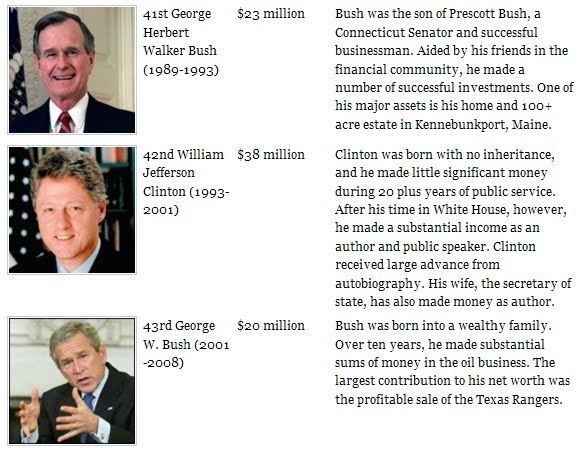
MP: What's interesting is that George Washington was probably the wealthiest U.S. president with $525 million of net worth, depending on how you count the entire Kennedy family estate of $1 billion towards JFK's net worth.  Also, it's pretty amazing that Bill Clinton's net worth of $38 million is almost as much as the combined net worth of both Bush Presidents together ($43 million total), see chart above.   

Monday, January 19, 2009

Chart of the Day: The Hope and Change Index

THE ECONOMIST -- How will Barack Obama measure up, compared with other presidents, in his inaugural address?

Barack Obama is fond of hope and change. By one tally, he said “hope” nearly 450 times in speeches delivered on the campaign trail. (By contrast, his rival John McCain only used the word 175 times.) “Change”, too, was a campaign buzzword. If Mr. Obama makes heavy use of both words in his inaugural speech he would be following in the footsteps of William Taft a century ago. Taft delivered the most “hopeful” inaugural speech of the past 100 years, and was keen on change, too. Only Bill Clinton, in his first speech in 1993, talked about change more (see chart above, click to enlarge).

While hope has found a place in each of the 25 inaugural addresses, change is used more sparingly. Six inaugural speeches did not contain the word; six more made use of it just once. Presidents coming to office during economic booms, such as Calvin Coolidge and Warren Harding in the 1920s, Dwight Eisenhower and then George Bush junior, have been heavier users of hope than those who were inaugurated during leaner times. By that yardstick, expect more change and less hope when Mr. Obama speaks.

Monday, November 12, 2007

Excessive College President Pay? Not Really

From today's NY Times article "Increased Compensation Puts More College Presidents in the Million-Dollar Club":

Soaring compensation of university presidents, once limited to a few wealthy institutions, is becoming increasingly common, with the number of million-dollar pay packages at private institutions nearly doubling last year, and compensation at many public universities not far behind.

Presidents at 12 private universities received more than $1 million in the 2005-6 school year, the most recent period for which data on private institutions is available, up from seven a year earlier, according to an annual survey of presidential pay to be released today by The Chronicle of Higher Education (subscription required). The number of private college presidents earning more than $500,000 reached 81, up from 70 a year earlier and just three a decade ago.

The survey also found that the number of public university presidents making $700,000 or more rose to eight in 2006-7, the reporting period for public institutions.

From The Chronicle: Among private institutions, the median compensation of leaders of research institutions rose 37% in the last five years of the survey, from $386,631 in 2001-2002 to $528,105 in 2005-2006 (see chart above, click to enlarge).

From The Chronicle's salary database, the highest paid private college president in 2005-2006 was Donald Ross, who earned $5.7 million at Lynn University. The highest paid public university president was Purdue's Martin Jischke, who earned $880,000 in 2006-2007. Note also that almost all college presidents get a free house, free car and expense accounts, in addition to deferred compensation, retention bonuses, performance bonuses, retirement pay and club dues.

MP: Since administrator pay has increased at a rate far above pay increases for faculty and staff pay increases, income inequality in higher education has increased significantly in recent years, perhaps just another industry-specific example that reflects an overall, general pattern of rising income inequality in the U.S. in many/most industries.

I really don't have any problems with college presidents' pay, just like I don't have any problems with Bill Clinton's speaking fees, or rising CEO pay, or the rising number of millionaires in China or India, or rising income inequality in the U.S., etc. See this previous CD
post where I suggest that the more competitive and dynamic the economy, the greater the natural amount of income inequality.

Bottom Line: College presidents are academic CEOs who are often managing very large organizations in an increasingly competitive environment, operating in an increasingly globalized market, facing declining public support for higher education, etc. Rising college president salaries are a reflection of an increasingly dynamic and competitive market for academic CEOs. Not to worry.