Tuesday, June 12, 2012

Taken for a Ride by the NYC Taxi Cartel


In a recent Slate.com article titled "Taken for a Ride," the authors ask a good question: "The taxi medallion system in New York and other cities raises fares, impoverishes drivers, and hurts passengers. So why can’t we get rid of it?"  Here are some excerpts:

"When New York’s Taxi and Limousine Commission held a public hearing last week to consider whether to raise taxi fares by 20 percent, cabdrivers pled poverty and passengers argued that fares are too high. Paradoxically, both groups were right.

This lose-lose scenario is only possible under the taxi medallion system, a regulatory scheme in which the right to operate a taxi is thoroughly divorced from the actual work of driving one. It’s a classic example of the perils of financialization, the process through which economic potential is turned into a liquid and leveraged asset. By converting a portion of cabbies’ future revenue into a freely tradable asset, New York, Chicago, San Francisco, and a host of other cities have created a powerful investor class, medallion owners and financiers, whose interests routinely compete with those of drivers and passengers.

“Compete” may be the wrong word, however, since owners of the aluminum placards don’t have much experience with losing. Over the last decade, their victories have driven the price of a medallion from around $200,000 to more than $1 million in New York (see chart above). Medallion owners from Boston to San Francisco have been similarly fortunate, with medallions in Chicago appreciating even faster than the sustained 16 percent per year gains seen in New York.

New York’s tight limits on the number of medallions in circulation has suppressed the supply of cabs. There are 13,237 medallions now outstanding, a few hundred fewer than in 1937, but a huge supply of drivers competing to lease them.  In practice, a fixed number of medallions is just a fact of the system. In New York, Chicago, and Boston, the number of medallions has barely budged since they were issued in the 1930s. New York went 60 years without issuing new medallions, and it's only been a trickle since.

Restricted supply makes for high medallion prices, and that in turn leads to consolidation in the industry. Only around 18 percent of cabs are owner-operated, putting most medallions in the hands of big taxi fleets or brokers who simply rent them out. The limited number of shifts and oversupply of drivers looking to work means that the fleets only rent out cabs by the shift, the shortest term, most profitable way possible."

MP: The "lose-lose" outcome of a taxi medallion system is a good example of "crony capitalism" that has allowed a private taxi cartel to operate in NYC and restrict the supply of taxis in the same way that OPEC can restrict the supply of oil.  Consumers lose, taxi drivers lose, while the medallion owners prosper.

What are the chances of any major changes to the taxi cartel? Probably none, as public choice economics would predict.  The medallion owners are too well-organized, too entrenched in the status quo, and they have the financial resources available for rent-seeking to protect their cartel status.  Taxi customers are dispersed and disorganized, and have limited resources to fight the cartel, so nothing will change. 

As one report on the industry concluded, “A taxi medallion system is nearly impossible to end even if it proves to be providing unfairly high gains to a limited number of original medallion owners. Medallion owners fiercely resist any possible threat that may challenge their advantage.”

The NYC taxi medallion system cartel is a good example of "government failure" and crony capitalism that harms consumers and impoverishes the citizens of New York City, while enriching a small group of wealthy, politically-connected rent-seekers.  Where's the outrage from the OWS crowd, this seems like it would be a good issue for them? 

Sunday, March 29, 2009

Privilege of Cartel Membership:Above-Mkt. Returns

Market Watch -- Medallion Financial Corp. (NASDAQ: TAXI), a specialty finance company with a leading position servicing the taxicab industry announced that earnings, or net increase in net assets resulting from operations was $2,832,000 or $0.16 per diluted common share in the 2008 fourth quarter.

Andrew Murstein, President of Medallion Financial stated, "We are very pleased with the year's results, especially given what has been a challenging environment for financial institutions. Underlying our performance is the collateral value we have in our medallion loans. In over 70 years of involvement in the medallion industry, we have experienced zero losses on any taxi medallion loan we have originated in New York City.

Additionally, taxi medallions are one of the few assets that have appreciated in value in 2008, increasing in every one of our operating markets, and have continued that trend thus far in 2009. Prices in 2008 for corporate medallions in New York City increased over 24% and are currently at all-time highs of $750,000 per medallion in March 2009 (see chart above, data here).

The taxi industry is somewhat insulated in this type of economic environment for several reasons from increased fleet utilization due to the influx of manpower from job losses in other industries, to more people riding taxis as corporations cut back on limos and other car services. In addition, our loan to value ratio on our entire medallion portfolio is now under 50%."

MP: The NYC taxi industry is also insulated very well from competition, since it operates as a cartel with legal restrictions on entry. According to the NYC Taxi and Limousine Commission, the official name of the NYC Taxi Cartel:

In 1937, the number of taxicab medallions was limited to those that existed at that time. By the late 1940s, this number had settled at 11,787. Since 2003, State and local legislation has allowed the Taxi and Limousine Commission (TLC) to sell new medallions, bringing the current total to 13,150 yellow medallion taxicabs operating in New York City. A new medallion is a rare opportunity.

MP: Yes, a rare opportunity to join a cartel with significant barriers to entry. And cartel membership does have its privileges, including above-market rates of return (see chart below). Since January 2004, the price of NYC taxi medallions has increased 2.6 times, while the S&P500 has declined by 28%.


Sunday, January 16, 2011

The Economics of Anti-Consumer, Protectionist Taxi Cartels: $624-850,000 for a NYC Medallion

The "priciest piece of aluminum in NYC" - a taxi medallion that is required to operate a single cab in NYC - reached a new record-high of $624,000 in December for an individual medallion (see chart above, data here), more than double the average price for a medallion in 2004. The average price for a corporate-owned taxi medallion reached a new record high of $850,000 at the end of last year. Here's a classic article about taxi regulation from Jeff Jacoby, written back in 1995 when the NYC medallions were selling for only $140,000:
The taxi business, after all, ought to be a model of free enterprise. There are plenty of buyers (passengers), plenty of sellers (drivers), and no barriers to entry beyond the price of a car. If it weren’t for government interference, the laws of supply and demand would govern the taxi trade with almost frictionless efficiency: Cabs would be plentiful, fares would be reasonable, and service would be available nearly everywhere it was wanted.

But governments do interfere. Taxi owners routinely get the state to kill their competition. “London’s first recorded taxi war, in 1636, did just that,” the Economist recalled some years ago. “Sparked by the resentment of Thames water taxis at growing competition from coaches on land, it led to a proclamation from King Charles I restricting the number of coaches to 50. Lucky coachmen were happy. Watermen were happy.” But customers got gypped.

A lot of medieval practices have been junked since 1636, but protectionist taxi regulations aren’t among them. Nearly every major US city (and thousands of smaller ones) chokes off access to the taxicab market. Exactly 11,797 taxicabs, for example, are permitted to operate in New York City — a figure that hasn’t budged since World War II. FDR was in his first term as president when Boston decreed that only 1,525 cabs would be permitted on its streets. Other than a few new medallions for wheelchair taxis, 1,525 remains the limit.

The results? Right out of Econ 101: The supply of taxi medallions is far lower than the demand, so their value long ago exploded to obscene levels. Today, the going rate is about $140,000 in New York; about $90,000 in Boston. Those who got medallions when the getting was cheap grew rich. Everyone else got shafted. Would-be cabbies are forced to choose between going deeply into debt to buy a medallion or paying murderous lease rates to somebody who owns one. “In essence,” write Chip Mellor and John Kramer of the Institute for Justice, “cab drivers become urban sharecroppers.”

Friday, December 18, 2009

Update on The "NYC Taxi Cartel"

NEW YORK (August 7, 2009) -- As Wall Street still wobbles under the pressure of a weak economy, one New York asset class stands firmly on all four wheels. Taxi medallions — required licenses fastened to the hoods of all New York City yellow cabs — have rocketed in value at a time when many investments have plummeted. The average rate in July for a corporate-licensed taxi medallion in the Big Apple was a record $766,000 — up 126% from $339,000 in 2004.

"It's an industry that has always gone up," says Andrew Murstein, president of Medallion Financial. "It has outperformed every index you can think of — the Dow, Nasdaq, gold, you name it."

In a ratio set by law, 40% of New York's 13,257 medallions — a number strictly controlled by the city — are designated for individual, as opposed to corporate, ownership. Individual owners are required to drive at least part time, while corporate owners have the option of hiring an agent to lease the medallion full time for up to $800 a week.

MP: That USA Today report was from July, and the "priciest piece of aluminum in NYC" - a taxi medallion to operate a single cab in NYC - has gone up another $13,000 since then, reaching a new record-high of $779,000 in November for a corporate medallion (see chart above,
data here), almost double the average price of $391,000 just four years ago in November 2005. The average price for an individually-owned taxi medallion also reached a new record high in November at $579,000, a two-fold increase since the summer of 2004.

Membership in the "taxi cartel" certainly has its privileges: above-market returns (18.1% per year for corporate medallions and 15.7% for individual medallions, vs. -0.52% per year for the S&P 500 since 2004), see previous CD posts
here and here.

Saturday, November 03, 2007

Taxi Cartel Membership Has Its Priveleges: Returns That Have Outperformed Every Major Index

NEW YORK -- The priciest piece of aluminum in NYC, a taxi medallion to operate a single cab (pictured above - you'll see them on the hood of every NYC taxi), just sold for as high as $385,000 when the Taxi and Limousine Commission staff unsealed 155 bids yesterday. The lowest winning bid was $277,777, and the average bid was $309,000.

Here is the
press release from the NYC Taxi Cartel, aka as the Taxi and Limousine Commission:

According to the
NYC Taxi and Limousine Commission, the official name of the NYC Taxi Cartel: "In 1937, the number of taxicab medallions was limited to 11,787. Today there are currently 13,087 yellow medallion taxicabs operating in New York City. A new medallion is a rare opportunity."

Yes, a rare opportunity to join a cartel with significant barriers to entry. And cartel membership does have its privileges, including above-market rates of return.

According to the president of Medallion Financial Corporation, the leading lender to the industry, "Taxi medallions have been one of, if not the single best investment to own over the years. While the Dow has gone up 8% per year over the last 50 years, taxi medallions have gone up almost double that, 14% per year. They have outperformed every major index including real estate, gold and other stock indexes."

(HT: Ben Cunningham)

Monday, October 30, 2006

NYC Taxi Cartel, I Mean Commission

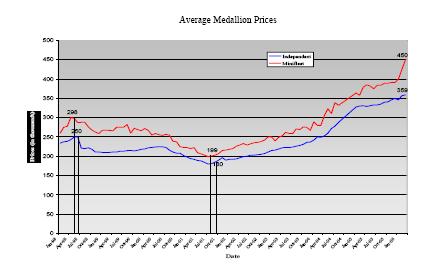
Over the last 5 years, NYC taxi medallion prices have more than doubled from $200,000 in October 2001 to an all-time high of $450,000 in 2006! Click here for a better view of the graph above. Note that a $450,000 medallion is the license required to operate only ONE taxicab in NYC!

Why so expensive? A medallion is the membership fee to join a taxi cartel, with a strict limit on the number of members competing for business in NYC. With such high barriers to entry, and strict limits on competition, the taxi cab cartel can charge monopoly prices, which then justifies paying $450,000 to join the cartel.

According to the NYC Taxi and Limousine Commission, the official name of the NYC Taxi Cartel: "In 1937, the number of taxicab medallions was limited to those that existed at that time. By the late 1940s, this number settled at 11,787 and was capped by law. Today there are currently only 12,779 yellow medallion taxicabs operating in New York City. A new medallion is a rare opportunity."

Yes, a rare opportunity to join a cartel. Membership has its privileges.

Tuesday, May 29, 2007

NYC Taxi Medallion Sells for Record $600,000

NEW YORK: The price of a New York taxi medallion reached a record $600,000. The previous record price Medallion financed was $550,000. Prices of corporate medallions have increased from $195,000 in 2001 to the record $600,000.

According to Andrew Murstein, president of Medallion Financial Corporation, the leading lender to the industry, "Taxi medallions have been one of, if not the single best investment to own over the years. While the Dow has gone up 8% per year over the last 50 years, taxi medallions have gone up almost double that, 14% per year. They have outperformed every major index including real estate, gold and other stock indexes."

Sure, it's a taxi cartel and entry is restricted, so wouldn't you expect better performance than the return on the stock of private companies, who generally operate without entry barriers?

Tuesday, March 30, 2010

Update on the NYC "Taxi Cartel"; Medallion Prices Reach Record Highs in 2010 of $588k and $779k

The "priciest piece of aluminum in NYC" - a taxi medallion to operate a single cab in NYC - reached a new record-high of $588,000 in February for an individual medallion (see chart above, data here), more than double the average prices in 2004. The average price for a corporate-owned taxi medallion reached a new record high in January at $779,000, and fell slightly in February to $775,000.

Membership in the "taxi cartel" certainly has its privileges: above-market returns of 20.75% per year for corporate medallions and 15.32% for individual medallions in a permanent bull market. See previous CD posts here,
here and here.

Saturday, September 25, 2010

Update on the NYC "Taxi Cartel"; Medallion Prices Reach Record Highs in Aug. of $609k and $825k

The "priciest piece of aluminum in NYC" - a taxi medallion to operate a single cab in NYC - reached a new record-high of $609,000 in August for an individual medallion (see chart above, data here), more than double the average prices in 2004. The average price for a corporate-owned taxi medallion reached a new record high in July and August at $825,000. 

Membership in the "taxi cartel" certainly has its privileges: above-market returns of 17% per year for corporate medallions and 15% for individual medallions in a permanent bull market.  Over the same period from 2004 to 2010, the average annual return on the S&P500 was -1.10%.  See previous CD posts here, here and here.

Saturday, July 04, 2009

Will D.C. Taxi Industry Become a Cartel Like NYC?

WASHINGTON EXAMINER -- The District’s open, all-are-invited taxicab industry is so saturated with drivers that the entire enterprise is threatened, according to a D.C. Council member who has filed a bill to cap the number of cabs allowed on city streets. Councilman Jim Graham introduced legislation to limit the number of taxicabs in D.C. through either a medallion system, like ones used in New York City and Chicago, or a certification system.

The soaring number of taxicab operators in D.C. -- roughly 8,000, most of whom own their own cars -- is a "pressing and urgent problem," Graham said. There are more licensed drivers in D.C. per capita than any place in the world, he said, and new applicants continue to take the required class, giving them access to the driver exam administered by the D.C. Taxicab Commission. A glut of drivers could jeopardize the chances of any cabbies making an adequate living, Graham has said.

New York City's medallion system, established in 1937 during the Great Depression in response to a ballooning number of unregulated taxis, artificially capped the number of cabs on the road, to what is now about 13,000. The medallion program, however, made it very difficult for the average New Yorker to join the industry as an owner: The May 2009 price for an individual medallion, those held by owner-operators, was $568,000. The cost of a corporate medallion was $744,000 (see chart above, medallion prices have more than doubled since 2004).

MP: Isn't this an example of a "pressing and urgent problem" that would easily solve itself without government intervention, and a problem that will probably be made significantly worse with government intervention? That is, if there really is an excess supply of taxis in D.C. relative to the demand for taxis, that surplus will be automatically corrected and eliminated by firms/drivers exiting the industry in response to low prices and low/negative profits.


Just like a shortage of taxis would be automatically corrected by firms entering the industry, attracted to the "smell of profits" created by the high prices. As long as the taxi industry has easy entry for new firms, and easy exit for existing firms, which seems to be the case, any surplus or shortage of taxis will automatically be eliminated.

By restricting the supply of taxis with costly medallions, that regulatory action will create a government-enforced taxi cartel, with an artificially low number of taxis and artificially high prices. Membership fees to join the cartel will became extremely expensive (more than half a million dollars to join the NYC Taxi Cartel), and the average person will be priced out of the cartel.

HT:
Coyote Blog

Thursday, July 07, 2011

The D.C. Taxi Hobgoblin and Government "Solution" to a "Non-Problem": Create a D.C. Taxicab Cartel

Is a Taxi Cartel Like This Coming to D.C.?


In the 1920s, H.L. Mencken said "The whole aim of practical politics is to keep the populace alarmed (and hence clamorous to be led to safety) by menacing it with an endless series of hobgoblins, all of them imaginary."   

Exhibit A: 

Taxicabs in Washington, D.C. are plentiful (estimated to number as high as 10,000), accessible and easy to find almost any time or day, and with fares cheaper by 20-25% than regulated, limited entry markets ("cartels") like NYC and Boston.  From my personal experience, most D.C. taxi drivers are owner-operators who enjoy working for themselves and being able to set their own hours.  As a group, the drivers are generally friendly and courteous.  In other words, it's a consumer-driven, market-based  industry with affordable fares and great service, and both the D.C. taxi drivers and D.C. customers are perfectly happy with the current system. 

So what's the problem?  There really is no problem, unless apparently you're an over-zealous, anti-market, meddling bureaucrat, and/or a large, anti-competitive taxi company with a self-interest in controlling a large share of a restricted market with high barriers to entry.  In that case, the government "solution" to D.C.'s "non-problem" with its taxicab industry is to create a "taxi cartel," by artificially restricting the number of DC taxicabs to only 4,000 (putting thousands of taxi drivers out of work), and charging a $10,000 cartel membership fee to purchase a special license called a "medallion." 

It's pretty easy to predict what will happen with a DC taxi cartel: There will be fewer cabs, the taxi fares will be higher, it will be more difficult to get a cab during peak demand, and customer satisfaction will deteriorate.   

And what will happen to D.C. medallion prices over time?  We can look to NYC to get an idea.  When NYC capped the number of taxis at about 12,000 in the 1930s, the first medallions sold for only $10 (about $157 in today's dollars). Medallions for individuals are now selling for $673,000 as of June 2011, an all-time record high (see chart above).  That's an annual return of 12.65% for owning NYC taxi medallions since 1937, more than double the 5.9% annual return for the Dow Jones Industrial Average over that same period, clearly demonstrating that "cartel membership has its privileges."

For more background and a Reason.tv video, see "D.C. Taxi Heist: How a new law would screw drivers and riders." 

Thursday, March 24, 2011

NYC Taxi Medallions Approach $1 Million!!

The price of a New York City taxi medallion (the "priciest piece of aluminum in NYC") that allows a corporate owner to operate a single taxi in the Big Apple is approaching $1 million. 

According to the New York City Taxi and Limousine Commission, four corporate taxi medallions sold in February at an average price of $950,000, setting a new all-time high record (see chart above).  Twenty individual taxi medallions were sold in February at an average price of "only" $641,000, which also sets a new record high for that category.

See previous CD posts on taxi medallions and the NYC "taxi cartel" here and here.  

Friday, October 21, 2011

Markets in Everything: $1 Million Taxi Medallions

New York Times -- "Two New York taxi medallions — aluminum plates that grant the right to operate a yellow cab — changed hands this week for $1 million apiece, the highest recorded sale since the city’s modern livery system began (see chart). The sale was the culmination of decades of astonishing growth for the humble medallion, which is nailed to the hood of every yellow cab in the city. When New York issued its first batch of medallions in 1937, the going price was $10 even, or $157.50 in today’s dollars.

Some perspective: The Dow Jones industrial average has risen 1,100 percent in the last 30 years. In the same period, the value of a taxi medallion is up 1,900 percent. That return beats gold, oil and the American house.

Corporate medallions, like the two sold on Wednesday, do not need to be driven by their owners and can be leased out 24 hours a day. Individual medallions, which make up about 40 percent of the fleet and must be occasionally driven by the owner, are worth slightly less: the latest sale was for about $700,000 (see chart).

There are 13,237 medallions in the city; new ones, when issued, are sold at auction. But the medallion pool is rarely expanded, creating a scarcity that helps keep values high. (Many owners have objected to a city proposal that would allow livery cabs to pick up street hails outside busy parts of Manhattan, saying such a plan would lower the value of their medallions.)"

MP: Membership in the "NYC taxi cartel" certainly has its privileges: above-market returns (17.4% per year for corporate medallions and 14.75% for individual medallions, vs. 0.83% per year for the S&P 500 since 2004), see previous CD post here, here and here.

HT: Colin Grabow

Sunday, May 27, 2007

Forget OPEC, What About The Taxi Cartels?


George Will explains in today's Washington Post what an immigrant can teach Americans about capitalism, rent-seeking and democracy, as taxi driver Luis Paucar tackles a twisted sense of entitlement in Minneapolis.

MINNEAPOLIS -- The campaign to deny Luis Paucar his right to economic liberty illustrates the ingenuity people will invest in concocting perverse arguments for novel entitlements. This city's taxi cartel is offering an audacious new rationalization for corporate welfare, asserting a right -- a constitutional right, in perpetuity -- to revenues it would have received if Minneapolis' City Council had not ended the cartel that never should have existed.

Paucar, 37, embodies the best qualities of American immigrants. He is a splendidly self-sufficient entrepreneur. And he is wielding American principles against some Americans who, in their decadent addiction to government assistance, are trying to litigate themselves to prosperity at the expense of Paucar and the public.

Read the rest of the article here, George Will deserves another Pulitzer Prize for this one.

The Institute for Justice (IJ) is representing Luis Paucar, and filed documents in U.S. Federal Court to join with the city of Minneapolis to defend the city’s free-market reforms that removed a cap on the number of taxis allowed to operate within city limits, read more about it here.

The Minnesota chapter of IJ already has four economic liberty victories under its belt despite being just two years old. The group recently published a 21-page paper titled "
The Land Of 10,000 Lakes Drowns Entrepreneurs in Regulations," which exposed the shocking state of economic liberty in Minnesota, including the taxi industry in Minneapolis.

For a chart of average NYC taxi medallion prices over time through 2006
click here, and for 2007 prices click here ($418,000 to $550,000 PER medallion, for ONE taxi license).

Tuesday, December 20, 2011

Wash DC Moves to Establish NYC-Style Taxi Cartel

The word "quota" appears four times in the draft of the District of Columbia's taxi reform bill, including this key phrase:

"The District of Columbia Taxicab Commission is authorized to establish a public vehicle-for-hire licensing quota which provides that the number of new taxicab vehicle licenses may be limited, after making a determination that the market is saturated with taxi vehicles and would benefit from a stabilization or reduction of new vehicles.”

Translation: Like NYC, Washington, D.C. is proposing to establish a "taxi cartel," with limited entry to restrict competition, resulting in higher fares, and possibly some kind of medallion system.   

HT: Washington Post via Colin Grabow


Wednesday, November 30, 2011

Why Does a NYC Taxi Medallion Cost $1 Million?

In case it's not obvious, this podcast from Planet Money answers the question. 

Wednesday, July 06, 2011

The D.C. Park Police Violate the First Amendment

"Why I Was Arrested at a D.C. Taxi Commission Meeting"


Here's Reason.tv Producer Jim Epstein's account of what happened:

"On June 22, 2011, I attended a meeting of the D.C. Taxi Commission for a story I'm currently working on about a proposed medallion system in the district. About half-an-hour into the meeting, I witnessed journalist Pete Tucker snap a still photo of the proceedings on his camera phone. A few minutes later, two police officers arrested Tucker. I filmed Tucker's arrest and the audience's subsequent outrage using my iphone.

A few minutes later, as I was attempting to leave the building, I overheard the female officer who had arrested Tucker promise a woman, who I presumed to be an employee of the Taxi Commission, that she would confiscate my phone. Reason intern Kyle Blaine, overheard her say, "Do you want his phone? I can get his phone." (The woman who was given assurances by the officer that she could have my phone can be seen at the end of the video telling me, "You do not have permission to record this!")

As I tried to leave, I was told by the same blond female officer to "stay put." I told her I was leaving and attempted to exit the building. I was then surrounded by officers, and told to remain still or I would be arrested. I didn't move, but I tried to get the attention of a group of cab drivers who were standing nearby. At this point I was arrested. I spent the remainder of the day in a cell in the basement of the building. I was released at about 4PM."

Read more here and here (letter from legal counsel for Jim Epstein and Reason).